




 Back to the blog
Languages
8 study techniques to learn a language faster
Mind maps, active recall, spaced repetition, shadowing, an error notebook and more: how to use each technique for any language, starting today.
Do you study and then forget everything a week later? It isn’t your memory: it’s the technique. These are the ones that have worked best for us, and they work for any language: Spanish, French, English, German. You don’t need all of them. Pick two or three and try them for a month.
1. Mind maps: see the whole topic at a glance
A mind map puts the topic in the middle and its parts around it: when it’s used, how it’s built, the exceptions. Instead of reading pages, you see how everything connects.
Why it works: your brain remembers what it sees organised, with colours and positions, far better than a list of rules.
How to use it: after studying a grammar topic, close the book and draw it on a blank page from memory. Then check what you left out. That gap is exactly what to review.
2. Active recall: test yourself instead of rereading
Rereading gives you the feeling that you know something. Trying to remember it without looking is what actually makes it stick.
How to use it: cover your notes and write the rule or the conjugation from memory. Then do the exercises without looking at the answers. Whatever you got wrong is what you need to review.
3. Spaced repetition: stop forgetting
You review new material just before you’d forget it: the next day, after 3 days, after a week, after 2 weeks and after a month.
Why it works: every review makes the memory last longer. With 5 well-spaced reviews, a word stays.
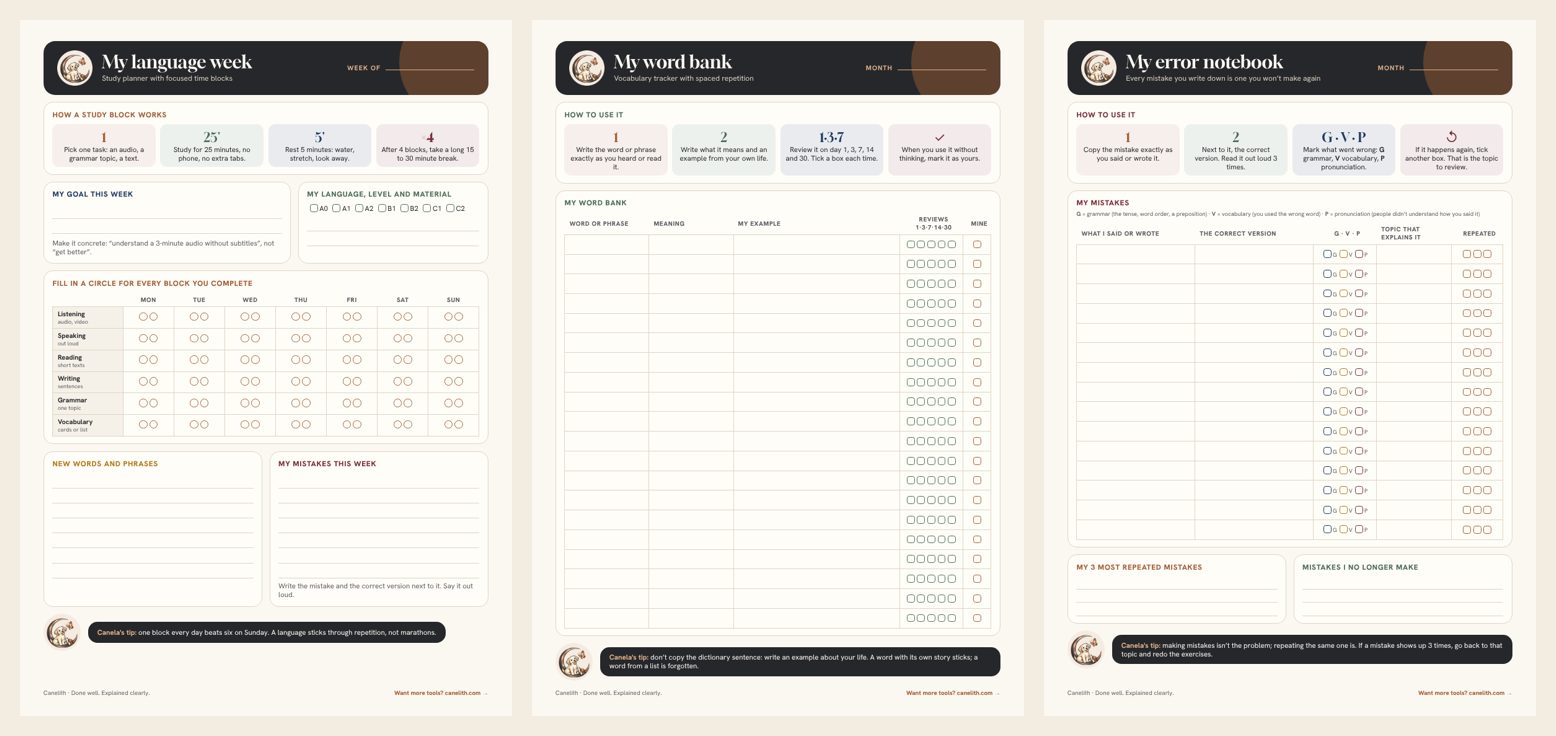
How to use it: write each word in My word bank with an example from your own life, and tick a box at each review.
4. Flashcards: vocabulary in your pocket
One side has the word or phrase in your language; the other side has it in the language you’re learning, with an example. Go through them on the bus, in a queue, in any free five minutes.
How to use it: on paper or in a flashcard app with spaced repetition (Anki, for example). Make cards for whole phrases, not single words: tomar una decisión, prendre une décision, not just decisión.
5. Shadowing: speak with the rhythm of the language
You listen to a short sentence and repeat it at the same time, copying the rhythm, the intonation and the sounds.
Why it works: you train your ear and your mouth together, without needing someone to talk to.
How to use it: choose a one-minute audio at your level with a transcript. Listen once, repeat sentence by sentence, then the whole thing in one go. Record yourself and compare.
6. One verb, every tense
Take one verb and write it in every tense you know: affirmative, negative and question.
Why it works: you stop seeing tenses as separate topics and start seeing the pattern. In Spanish or French you’ll see which endings repeat; in English, that the verb barely changes and the auxiliaries do the work.
How to use it: one verb a week, on a single page, from memory. Then check it against a conjugation site and add the corrections to your error notebook.
7. Error notebook: learn from what you get wrong
Every time someone corrects you or you spot a mistake, write it down with the correct version and mark what went wrong: grammar, vocabulary or pronunciation.
Why it works: most of us repeat the same 10 or 15 mistakes. Once they’re written down, you know exactly what to study.
How to use it: use My error notebook. If a mistake shows up 3 times, go back to that topic and redo the exercises.
8. Time blocks: study without distractions
You study for a fixed time on a single task with your phone away, then rest. The best-known version is the Pomodoro (25 minutes plus 5 of rest), but if you focus well, try 50-minute blocks with 10 minutes of rest.
How to use it: the number doesn’t matter; not switching tasks in the middle of a block does. Tick each block in My language week and fill in the day in My language year so you never break the streak.
Put the techniques into a routine
A normal day: 5 minutes of flashcards, one block on a grammar topic using active recall, 10 minutes of shadowing and 2 minutes to note your mistakes. You’ll find it step by step in the language study routine that actually works.
Free planners
- My language week: fill in a circle for every study block, skill by skill.
- My language month: one grammar topic per week and a calendar to keep the streak.
- My language year: the whole year on one page, coloured by what you did each day.
- My word bank: vocabulary with spaced repetition.
- My error notebook: every mistake written down is one you won’t repeat.
Looking for free material? Start with our guides to learning Spanish for free and learning French for free.